The Zero-Crossing Secret: Eliminate Compression Distortion Forever
The Zero-Crossing Secret: Eliminate Compression Distortion Forever
Every audio engineer has been there. You dial in what feels like the perfect compression setting, only to hear that subtle but unmistakable roughness creeping into the signal. It's not clipping. It's not saturation. It's the kind of distortion that lives just below conscious awareness, making your mix sound slightly harsh, slightly fatigued, slightly wrong. And most engineers never realise where it comes from.
The culprit? Your compressor is changing gain in the middle of a waveform cycle.
The Problem Nobody Talks About
Traditional compressors apply gain reduction as a continuous, time-varying envelope. The attack and release circuits respond to the signal level, and the resulting gain curve is applied to the audio in real time. Sounds reasonable. But here's the issue: that gain curve doesn't care where it lands on the waveform.
Imagine a sine wave at 100 Hz. The compressor decides to reduce gain by 3 dB. If that change happens while the waveform is at its positive peak, the waveform shape itself gets distorted. What was a smooth curve now has a tiny discontinuity, a wrinkle in the fabric of the signal. Multiply that by thousands of gain changes per second across a complex mix, and you get intermodulation distortion. Not the dramatic kind. The sneaky kind that makes people say "this mix sounds compressed" without being able to point to exactly why.
This is not a flaw in any particular compressor. It is baked into the fundamental architecture of how nearly every dynamics processor has worked for decades. Attack and release circuits are essentially smoothing filters applied to a control signal, and they operate on their own timeline, completely independent of the audio waveform beneath them.
What Zero-Crossing-Gated Gain Actually Means
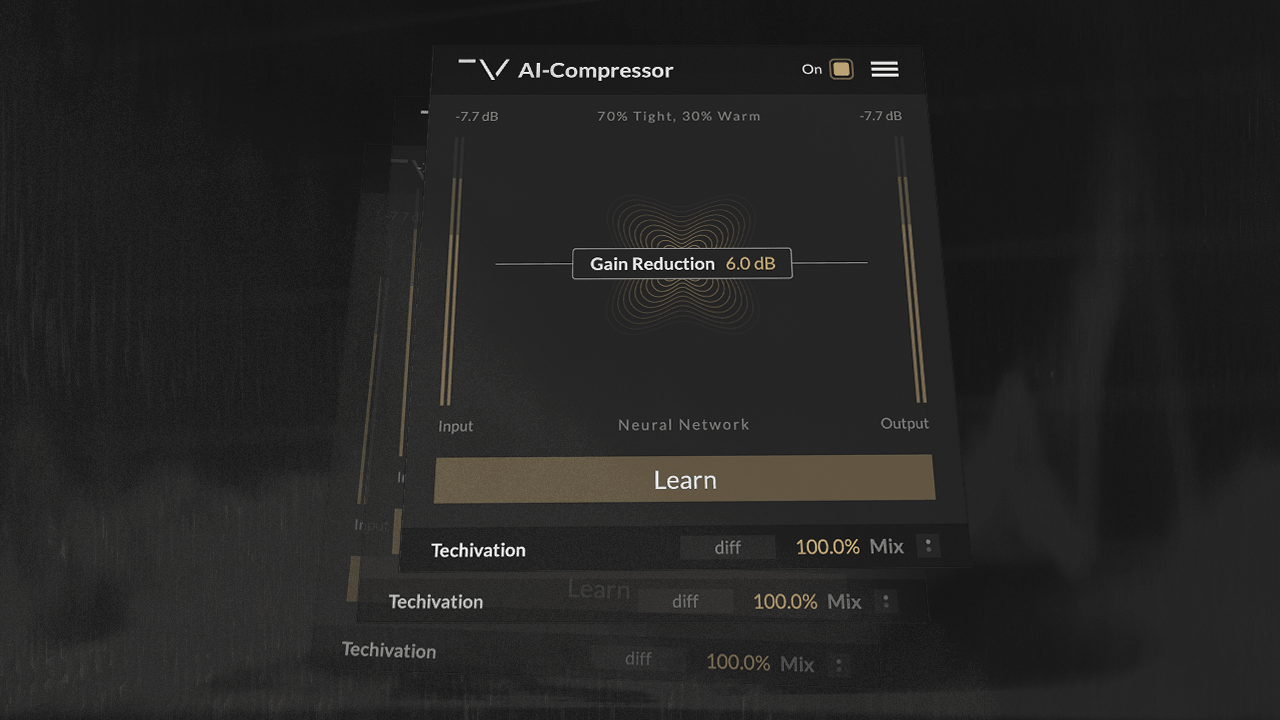
Techivation's AI-Compressor takes a fundamentally different approach. Instead of applying gain changes whenever the envelope dictates, the compressor's gain reduction is only allowed to decrease at zero crossings of the audio waveform.
A zero crossing is the moment the waveform passes through the zero-amplitude line, transitioning from positive to negative or vice versa. At this exact point, the signal amplitude is at or near zero. Changing gain at this moment has the least possible impact on waveform shape, because you're adjusting the amplitude of something that is momentarily silent.
The result is that gain transitions happen in sync with the natural rhythm of the audio itself, not on an arbitrary timeline set by attack and release ballistics. The compressor effectively locks its gain changes to the waveform, eliminating the intermodulation artefacts that plague conventional designs.
This is not a subtle tweak. It is a structural rethinking of how dynamic gain is applied to audio.
Why This Matters More Than You Think
If you have ever A/B tested a compressed signal against the original and noticed that the compressed version sounds "smaller" or "flatter" even at modest settings, intermodulation distortion is almost certainly part of the reason. It adds a gritty, slightly smeared quality that fills in the spaces between notes and reduces the sense of openness in a mix.
Engineers often try to solve this by using slower attack times, gentler ratios, or parallel compression to preserve the character of the original signal. These are workarounds. They reduce the symptoms by reducing the amount of compression, but they don't address the root cause.
With zero-crossing-gated gain, you can compress harder without the penalty. The dynamic range reduction happens cleanly because the gain changes are physically aligned with the waveform. There's nothing to smear, nothing to modulate, nothing to distort.
The Bigger Picture: Contour-Based Compression
The zero-crossing approach in AI-Compressor doesn't exist in isolation. It sits inside a larger architecture that replaces traditional attack and release envelopes entirely.
Instead of tracking instantaneous peaks or RMS levels through a ballistic filter, AI-Compressor builds what's called a level contour. This is a smoothed representation of the signal's macro-dynamic shape, computed using a sliding window analysis with lookahead. The contour captures the broad dynamic movements of the audio without reacting to individual transient spikes or momentary level changes.
This contour drives the gain reduction, and the zero-crossing gating controls how that gain reduction is released back. Rising gain (meaning more compression) can happen immediately, because increasing attenuation on a signal doesn't distort the waveform shape. But falling gain (releasing compression) only happens at zero crossings, with a smoothing factor that depends on how far the level has dropped and how much transient energy is present.
The combination means AI-Compressor can track dynamics precisely while releasing compression in a way that is mathematically guaranteed to minimize waveform distortion. It's the difference between a compressor that fights the audio and one that moves with it.
What This Sounds Like in Practice
In practice, the difference shows up most clearly on sources with complex harmonic content. Vocals, acoustic guitars, full mixes, and anything with significant midrange detail will sound noticeably cleaner through AI-Compressor at the same gain reduction settings compared to a conventional compressor.
The transients stay intact, not because the compressor is too slow to catch them, but because the 25-millisecond lookahead means it sees them coming and the contour system handles them without the overshoot and recovery artefacts typical of fast attack settings.
The low end stays solid because the perceptual weighting system adjusts compression sensitivity across the frequency spectrum, but the zero-crossing gating ensures that even the gain changes driven by low-frequency content don't create intermodulation with higher harmonics.
And the overall result is a signal that sounds louder, tighter, and more controlled, but still sounds like itself.
The Takeaway
Compression distortion is not inevitable. It is an engineering choice that has gone unquestioned for a long time. The zero-crossing-gated gain approach in Techivation AI-Compressor proves that there's a better way: align gain changes with the audio waveform instead of ignoring it.
For engineers who care about transparency, who want to compress without compromise, and who have wondered why their compressed tracks never quite match the clarity of the original, this might be the answer you didn't know you were looking for.
Share this Article
Featured in this post
![M-EQ Review By Czar [Video]](https://cdn.sanity.io/images/9uzzx98j/production/341fd252af5cfdce3815b27290e6ccf6b1185b98-1280x720.jpg)